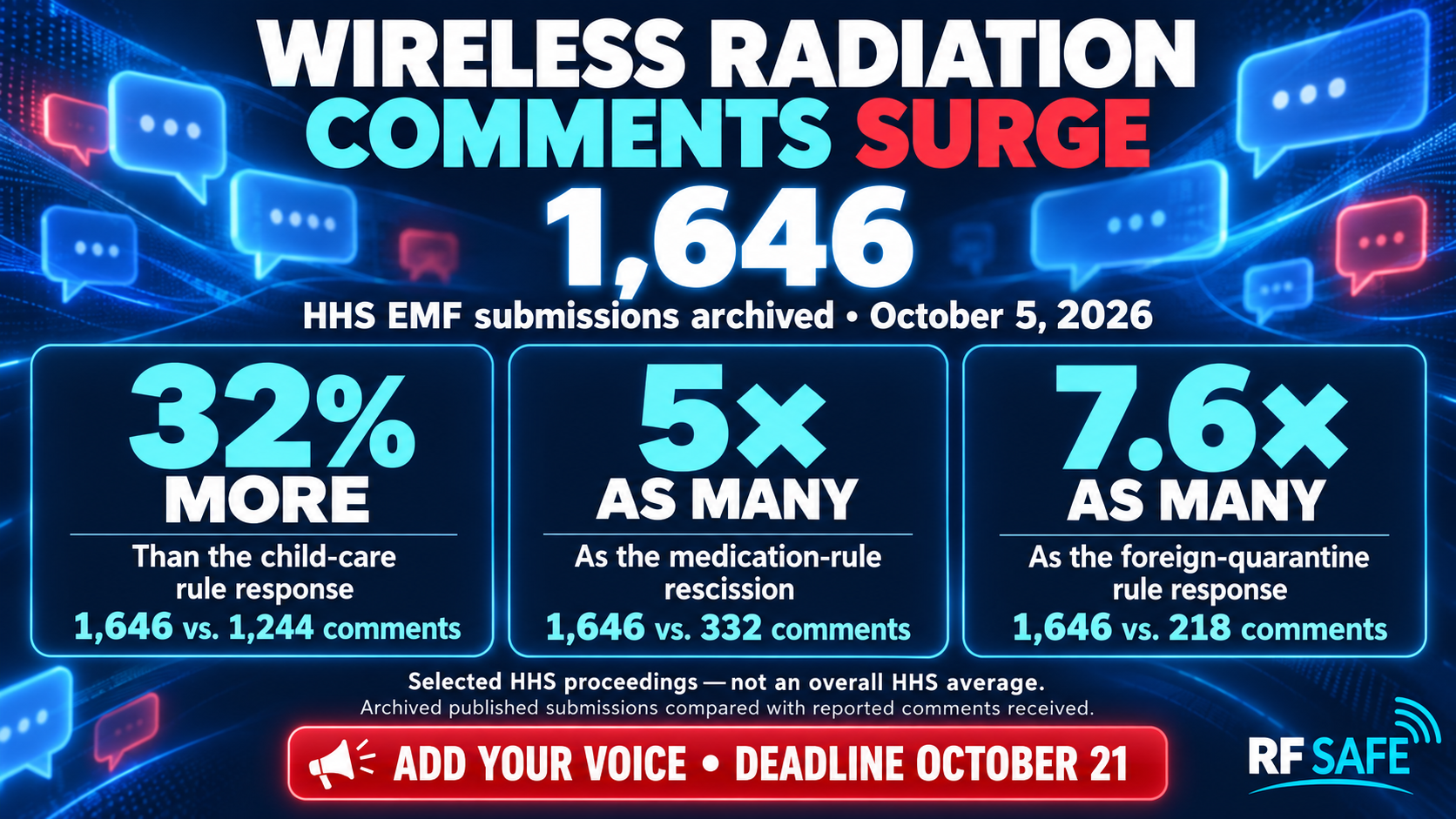
HHS’s wireless-radiation review has already drawn more archived submissions than several completed federal health proceedings—including 32% more than a recent child-care rule. This is a public-health conversation, and your voice belongs in it.
A parent worried about wireless exposure at school. A worker asking about cumulative exposure. A patient seeking research into symptoms that have never received a satisfactory explanation.
These concerns deserve a place in the public record.
As of October 5, RF Safe’s archive contains 1,646 published submissions to the Department of Health and Human Services’ request for information on electromagnetic fields, radiofrequency radiation, and wireless exposure.
The deadline is October 21.
Submit your comment to HHS here.
The response already deserves attention. Consider how it compares with three other HHS proceedings that each offered a 30-day comment period:
HHS proceedingReported comments receivedComparison with 1,646 archived EMF submissions2026 Child Care and Development Fund rule1,24432% more2021 rescission of the insulin and epinephrine medication rule332About 5 times as many2020 foreign-quarantine entry restriction rule218About 7.6 times as manyThe comparison counts come from the agencies’ published final rules. These are selected proceedings, rather than a measure of the overall HHS average. The EMF figure counts archived published submissions; the other figures count reported comments received. They measure submissions, rather than unique people or agreement with any particular position.
Even with those distinctions, the comparison is striking: an unfinished wireless-radiation consultation has already attracted more submissions than several completed HHS proceedings involving consequential public-health policies.
That is meaningful civic participation.
The archive added 377 submissions between its September 30 and October 5 snapshots. If that pace continued, the archive could approach 2,850 submissions by October 21. Publication delays and batches make that a rough projection, rather than an official forecast.
But the public does not have to wait for a milestone to participate.
A federal opportunity deserves a link—not just a verdict
Scientific American’s September 22 article covered the HHS initiative largely through skepticism about the value of personal accounts and reassurance about wireless exposure. It mentioned the public request, but the article version we reviewed provided neither a direct submission link nor the October 21 deadline.
Readers deserved both.
A news organization can challenge a hypothesis, evaluate research quality, and interview skeptical experts while still telling readers how to participate in a federal public-health review.
An invitation to submit evidence should not disappear inside a debate about the official who announced it.
RF Safe’s position is straightforward: people should be able to find the door to the public record.
Regulatory agreement does not settle every scientific question
A regulatory standard establishes a framework for compliance. Scientific understanding develops through experiments, replication, exposure assessment, and the investigation of findings that existing frameworks may not fully explain.
Those processes serve different purposes.
Compliance with an exposure limit is relevant information. It cannot, by itself, answer every question about exposure duration, modulation, cumulative exposure, susceptible populations, or biological mechanisms.
HHS’s own request recognizes the need to examine these questions. It asks about evidence below current federal limits, research gaps, sensitive populations, and whether changes could improve exposure assessment and regulation.
The public is being invited to help shape that investigation.
Biology communicates through voltage, timing, and feedback
Living tissue has an electrical organization.
Membrane voltage helps regulate cellular behavior. Ion channels and intercellular connections contribute to signaling networks. Changes in voltage can interact with calcium signaling and other pathways involved in development, repair, and tissue organization. These roles are established subjects of bioelectric research.
That makes signal integrity a serious biological question.
RF Safe uses “low-fidelity biology” to describe a proposed loss of precision in the signals cells use to coordinate their activity. In this framework, a cell’s ability to interpret its environment depends on the quality and timing of the information it receives.
The concern is that persistent interference could affect biological coordination before producing an obvious injury.
The nonlinear behavior of biological systems matters here: feedback and thresholds can make an outcome depend on timing and physiological state, rather than simply scaling with an input. Research modeling coupled voltage and calcium dynamics illustrates that complexity.
RF Safe’s “meta-disease” hypothesis extends this idea: impaired coordination could create an underlying state of vulnerability that manifests differently across tissues and individuals.
This is a research framework to test. Established bioelectric physiology does not, on its own, demonstrate that everyday wireless exposure produces that state.
The scientific task is to investigate the proposed connection with well-characterized exposures, meaningful biological measurements, and reproducible experiments.
The civic task is to insist that worthwhile questions receive that investigation.
Public participation is evidence of engagement
The growing comment record shows that people are willing to spend time placing information, experiences, and concerns before a federal health agency.
It does not tell us what percentage of Americans share a particular view. It does not establish causation. It does establish participation.
For people who have spent years asking for more research, better exposure information, and greater attention to children and other potentially susceptible groups, this opening matters.
Personal observations can help identify questions for further study. Research submissions can identify findings and methodological disputes. Clinicians can describe patterns that warrant investigation. Communities can explain what information they need to make informed decisions.
A useful review can examine all of those contributions critically without treating the people submitting them as an inconvenience.
Make your concern part of the record
You do not need to endorse RF Safe’s framework to participate.
If you believe wireless exposure is under-researched, explain where the gaps are. If you believe current protections are inadequate, identify the changes you want evaluated. If you have relevant research, provide its citation and explain its relevance.
HHS welcomes public experiences and supporting evidence. It asks respondents to identify their perspective, reference relevant question numbers, and submit one response per person or organization. Comments become public, so follow its instructions about excluding sensitive personal and health information. The deadline is October 21, 2026.
Explore submissions in RF Safe’s public-comment forum.
Review RF Safe’s comment archive data.
Public health deserves public participation. Share the submission link—and put your own voice in the record before October 21.