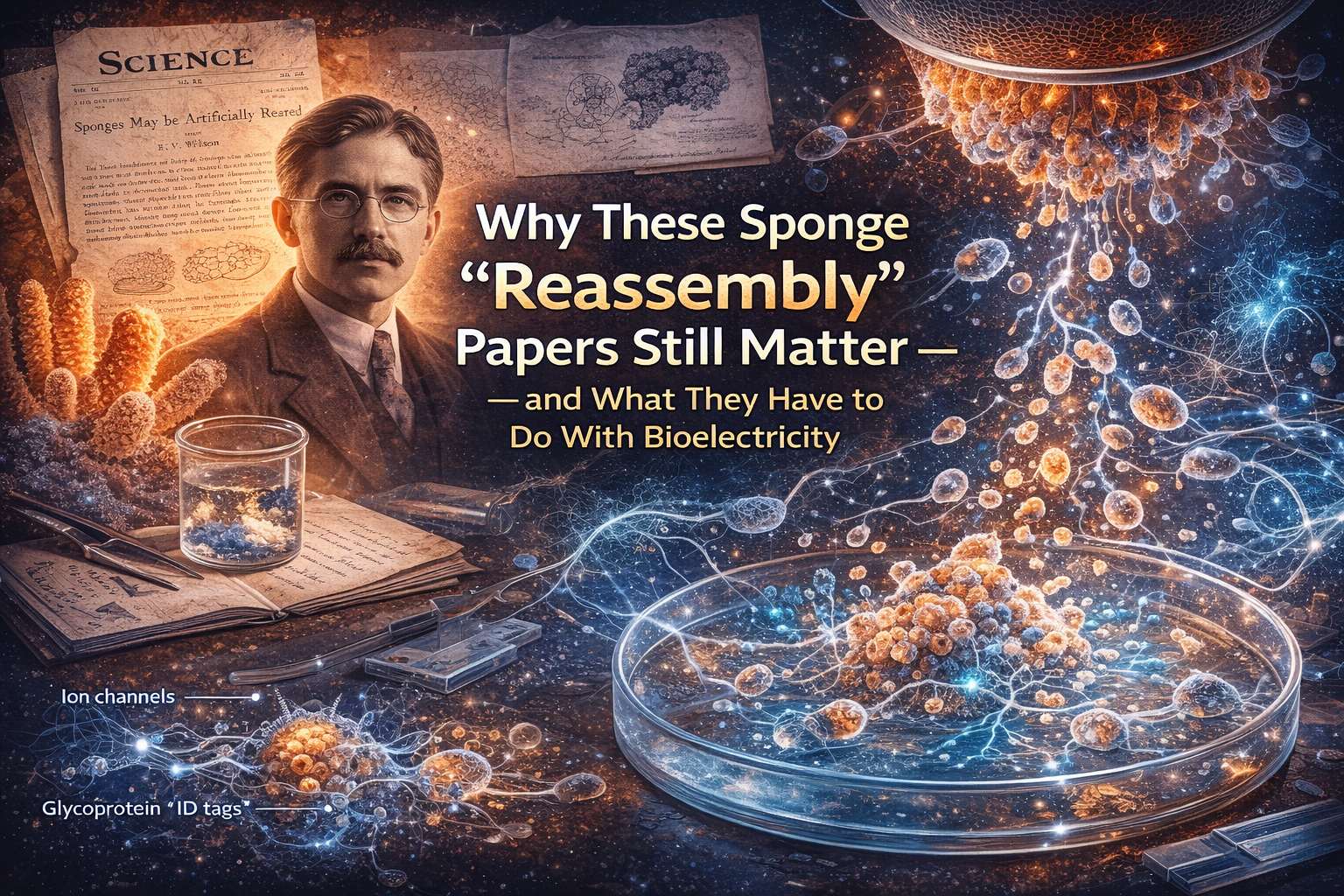
In 1907, biologist H.V. Wilson did something that still feels impossible: he forced a living sponge through a fine mesh, turning it into a “cell soup,” and watched those dissociated cells re-aggregate and rebuild a functional organism. Even more striking, when cells from different sponge species were mixed, they sorted themselves back into their own species instead of forming a blended chimera.
That early work is now recognized as one of the first clear demonstrations that complex living structure is not only encoded in genes, but also emerges from cell–cell coordination rules—recognition, adhesion, signaling, and collective decision-making.
The modern mechanism: adhesion + extracellular matrix “ID tags”
Subsequent research identified species-specific aggregation factors (extracellular proteoglycan/glycoprotein complexes) and their corresponding cell-surface binding partners/receptors. This is the biochemical “handshake” that lets cells:
-
Recognize who belongs together
-
Reassemble into coherent tissue
-
Recreate organized architecture after disruption
Where bioelectricity enters the story
Bioelectricity is the layer that helps explain how a pile of correctly matched cells becomes an ordered body plan, not just a clump.
Every living cell maintains a membrane voltage (Vmem) using ion channels and pumps. When cells touch and communicate (via adhesion molecules, junctions, and the extracellular matrix), they don’t just exchange chemistry—they also coordinate electrical states:
-
Voltage gradients can act like “spatial instructions,” telling cells where they are in relation to a larger pattern.
-
Ion channels and membrane potential influence gene expression, cytoskeletal tension, migration, and differentiation—exactly the kinds of decisions required for reassembly.
-
Adhesion and ECM mechanics feed back into electrical signaling: physical contact changes channel behavior, junction connectivity, and local ionic environments, which can shift cellular Vmem and collective patterning.
In other words: Wilson’s sponge wasn’t just re-sticking itself together. It was demonstrating that multicellular organisms have distributed coordination systems—and bioelectric signaling is a plausible, experimentally supported part of that coordination toolkit alongside chemistry and mechanics.
Why this matters today
These papers sit at the crossroads of:
-
Regeneration and tissue engineering (how to rebuild structures, not just grow cells)
-
Cancer biology (loss of adhesion and breakdown of coordinated signaling)
-
Organoids and synthetic multicellularity (self-organization in vitro)
-
Bioelectric medicine (controlling pattern formation by modulating electrical states)
These links below trace the evolution of the idea from Wilson’s original “cell soup reassembly” to modern molecular explanations—aggregation factors, receptors, and extracellular matrix toolkits—that make self-organization possible.
Primary / historical sources (Wilson-era) H.V. Wilson (1907), Science — A new method by which sponges may be artificially reared (the classic “squeezed through bolting cloth” dissociation/reaggregation report) PubMed record: pubmed.ncbi.nlm.nih.gov DOI: doi.org H.V. Wilson (1907), Journal of Experimental Zoology — On some phenomena of coalescence and regeneration in sponges (often cited alongside the Science note) Semantic Scholar record (with DOI): semanticscholar.org NOAA PDF (historical compilation referencing Wilson’s methods) — includes “pressed out through bolting cloth” and cites Wilson’s 1907 work spo.nmfs.noaa.gov Mechanism / “why cells know how to rebuild” (aggregation factors, receptors, ECM-like adhesion) Lavrov & Kosevich (2014) review (PDF) — Sponge cell reaggregation: mechanisms and dynamics of the process (covers species-specific sorting and classic Wilson lineage) wsbs-msu.ru Fernàndez-Busquets et al. (1997) — aggregation factor core protein; describes sponge AFs as extracellular proteoglycan-like complexes involved in species-specific recognition/adhesion sciencedirect.com Varner et al. (1988) — cell-surface proteins binding Microciona prolifera aggregation factor (receptors / ECM interface) pubmed.ncbi.nlm.nih.gov Müller et al. (1976) — classic “species-specific aggregation factor” receptor work (Geodia cydonium) pubmed.ncbi.nlm.nih.gov Ruperti et al. (2024), PNAS — proteomic/structural analysis connecting sponge aggregation factor to cell–cell / ECM interaction toolkits PNAS: pnas.org Open PMC version: pmc.ncbi.nlm.nih.gov BioRxiv preprint: biorxiv.org Modern context (why this experiment is still cited) Organoids history review (2020, PMC) — explicitly references Wilson (1907) as early in vitro “self-organization” precedent pmc.ncbi.nlm.nih.gov Marine Biological Laboratory (MBL) exhibit — credible historical summary and context for Wilson’s sponge reaggregation work mbl.edu