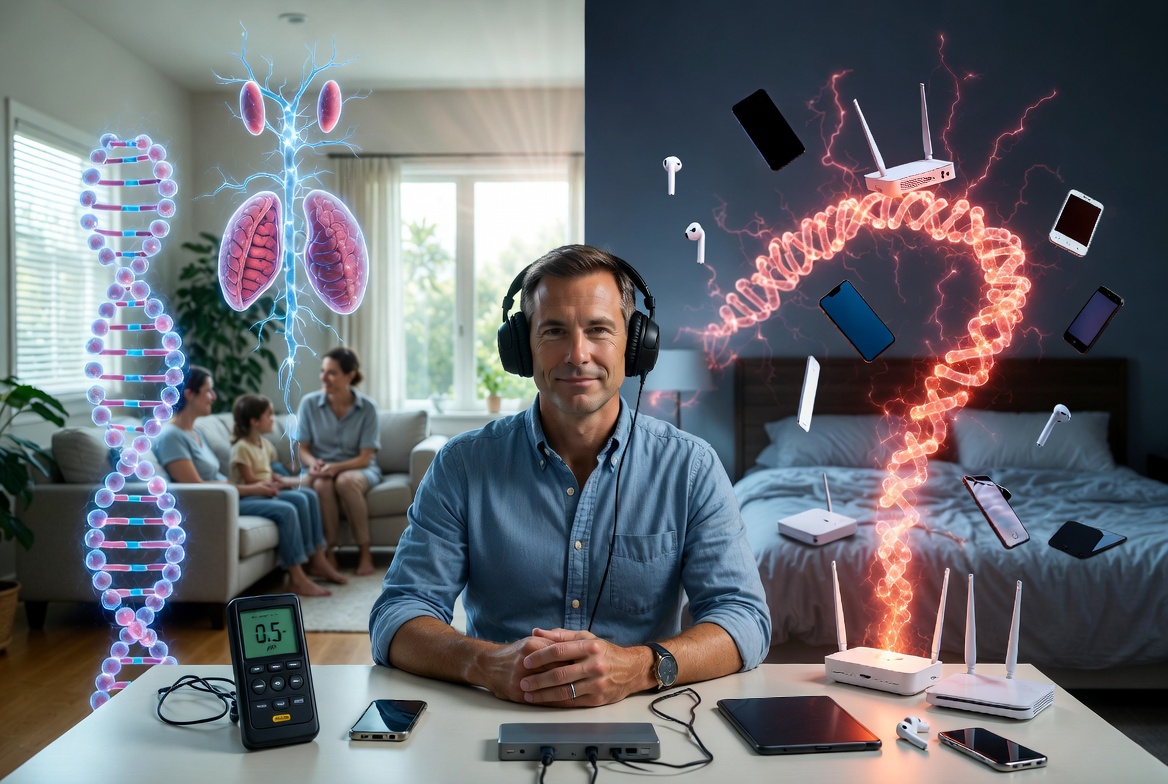
Mitochondria, Light, Magnetism, and the “Biological Envelope” We’ve Left Behind

This conversation is a two-hour deep dive into one radical (but strangely coherent) idea: Learn more about Regenerative Health Podcast with Dr Max Gulhane linktr.ee
Modern disease isn’t just “bad genes” or “bad luck.”
It’s what happens when humans live outside the environmental conditions our biology evolved to run inside.
Professor Alistair Nunn (Guy Foundation; quantum biology / bioenergetics focus) and Dr. Max Gulhane frame health like an engineering problem: not “one magic supplement,” but whether we’re operating inside a Goldilocks zone—an adaptive metabolic envelope shaped by evolution.
And the punchline is blunt:
we’ve changed the inputs (light, sleep timing, movement, magnetism, diet, temperature, electromagnetic noise) faster than biology can re-tune… so we’re getting a civilization-wide drift toward mitochondrial dysfunction, metabolic syndrome, inflammation, and accelerated aging.
Below are the key nuances—especially the ones that disappear when people reduce this to “get more sun” or “touch grass.”
The Big Frame: “Health” Isn’t a Thing You Add — It’s a Zone You Stay Inside
One of the most valuable concepts in the video is the shift from interventions to environmental operating conditions.
Nunn’s core argument is evolutionary and systems-based:
-
Life evolved on Earth, inside Earth’s gravity, geomagnetic field, and solar light environment.
-
We’re not “infinitely adaptable.” We’re highly adaptive within limits.
-
When we exit those limits, we don’t instantly collapse—we degrade: sleep drift → mitochondrial stress → inflammation → metabolic dysfunction → disease expression.
That’s why the video keeps returning to the same triad the Guy Foundation has built seminars around:
-
Light
-
Water
-
Magnetism
…with gravity/movement as the “obvious fourth input” that we ignore until we look at astronauts.
The claim isn’t that any single factor “causes” everything. The nuance is that multiple missing inputs stack—and the stack is what breaks resilience.
A Radical Thermodynamics View: Life as a “Dissipative Structure”
Early in the conversation, Nunn introduces a deep thermodynamics idea associated with dissipative systems:
-
If you have an energy gradient (hot vs cold; sun vs shade; vent vs ocean), matter can self-organize in ways that accelerate dissipation of that gradient.
-
In that view, life isn’t an anomaly—it’s what physics tends to do when the conditions allow it.
This is why he says the provocative line that life “accelerates the heat death of the universe.” Whether you love that framing or hate it, the practical point is:
Life is an energy-processing system.
Health is how cleanly and coherently you process energy without shredding the machinery.
Which leads straight into mitochondria.
Mitochondria: The Electrical Engine Everyone Underestimates
The conversation keeps hammering one point: mitochondria aren’t just “batteries.” They’re electrical field machines managing electron flow, proton gradients, redox signaling, ROS signaling, and energy conversion.
A few nuances they emphasize:
1) The “millions of volts” mental model is about scale
They reference the idea (popularized by Nick Lane in various discussions) that the electric field across the inner mitochondrial membrane, when scaled, is equivalent to a massive voltage gradient. The point isn’t the literal number—it’s the implication:
Inside you are millions of nanoscale electric engines.
Tiny perturbations can cascade.
2) Mitochondria run in a controlled “inefficiency” range
They discuss uncoupling and the idea that mitochondria aren’t 99.9% “efficient” in the way people imagine. They’re tuned to a steady-state regime where:
-
too high membrane potential → more ROS
-
too low membrane potential → you can’t do the work
-
stress shifts the tuning and forces compensations
That “Goldilocks tuning” inside mitochondria is a recurring theme.
3) Mitochondria are also signaling organs
A major nuance: mitochondria don’t just make energy—they shape:
-
immune signaling
-
calcium dynamics
-
stress responses
-
growth vs apoptosis decisions
-
tissue coordination
So when mitochondria drift, everything drifts.
Origins of Life: Why Thermal Vents, Iron-Sulfur, and Magnetism Keep Appearing
They spend a long stretch on origins because the argument is: the oldest constraints never left.
The vent story matters because it’s “gradient + chemistry + structure”
Thermal vents bundle:
-
steep gradients
-
catalytic environments
-
iron-sulfur chemistry
-
proton availability
-
structured surfaces
Nunn’s point is: even if vents aren’t the only origin theory, they represent a plausible environment where “energy gradients + matter → self-organization.”
Magnetism comes in via electron flow and spin/coherence
The key nuance: if biology depends on electron transport, and quantum mechanics tells us electron behavior can be sensitive to magnetic fields, then:
Changing magnetic field context can be a biological stressor.
He connects this to space research: beyond Earth’s protective magnetic environment, organisms show stress signatures. That’s part of why the Guy Foundation is doing a dedicated magnetism series.
The Space Mirror: Why Astronaut Biology Reveals the “Input Stack”
One of the clearest sections is where space becomes the fast-forward model for what’s happening on Earth.
In space you lose or distort:
-
gravity stimulus (movement loading)
-
magnetic field context
-
circadian timing cues
-
natural light spectrum exposure
…and the reported outcome is rapid mitochondrial dysfunction and accelerated aging-like changes.
Then Max makes the leap:
we’re simulating a milder version of space stress on Earth, by:
-
destroying circadian signals with light at night
-
living indoors in near-infrared-depleted environments
-
stacking chronic metabolic stressors (processed food, inactivity, stress)
-
adding non-native electromagnetic exposures into the baseline
You don’t have to agree with every detail to feel the core logic:
Remove the ancient inputs long enough, and biology stops behaving like it’s in Earth’s “operating system.”
Light: Not “Vitamin D” — A Full-Spectrum Control Signal
This is where the video has the most hidden nuance, because people love to reduce sunlight to one molecule.
1) UV has benefits and risks — the argument is hormesis
They keep returning to hormesis:
-
low/moderate dose → adaptation, resilience signals
-
excessive dose → damage
This becomes the framing for UV exposure: not “sun is always good” or “sun is always dangerous,” but dose and context.
2) Melanin evolution suggests selective pressure beyond “just vitamin D”
They discuss how quickly skin pigmentation shifted as humans moved north, and argue the speed of that shift implies strong survival pressures—likely involving multiple UV-linked pathways, not a single vitamin story.
3) Infrared is not decoration — it’s a missing modern input
A major nuance that people miss: modern indoor life can be near-infrared dark compared to the outdoors.
They argue infrared penetrates deeper and may interact with mitochondria and tissue physiology in ways that matter for recovery and resilience. Not as magic—more like a missing baseline.
“Photobioelectricity”: The Conversation Nobody Is Ready For
This is one of the most interesting stretches, because it’s where the discussion gets careful instead of hypey.
They explore the possibility that biology’s “electrical” nature might also be light-linked internally:
-
cells are packed with chromophores
-
electron transport complexes respond to light by wavelength
-
low dose can stimulate; high dose can inhibit (again: hormesis)
The biophoton nuance that matters
They make a point many influencers skip:
-
There’s a real phenomenon of ultraweak photon emission linked to metabolism/stress.
-
But a lot of “biophoton” measurements can be contaminated by delayed luminescence (materials acting like photon batteries after exposure to light).
-
So if you want real science here, you need extreme measurement discipline.
The important takeaway isn’t “cells are glowing like fireflies.” It’s:
Light and electron flow are coupled in biology more than mainstream medicine admits.
If you’re serious, you must separate real signals from artifact.
Cancer as “Loss of Cooperation” (and Why Environment Matters)
They treat cancer less as “random genetic bad luck” and more as a reprogramming state:
-
mitochondria aren’t always “broken”; they can be repurposed
-
redox signaling is managed, not accidental
-
proliferation often requires tuned oxidative signals (too little or too much kills growth)
Then they connect to a broader bioelectric idea (aligned with Michael Levin’s framing): cancer can look like a state where cells stop cooperating with the multicellular plan.
Whether you accept that model fully or not, this part of the conversation does something valuable: it shifts the question from “what mutation caused it?” to:
What environment pushed the system into a different program?
That’s the same “Goldilocks envelope” idea applied to pathology.
Metabolic Syndrome: The Quiet Accelerator Behind Everything
Late in the episode, the conversation turns clinical and brutally practical:
-
visceral fat and ectopic fat distribution matter more than BMI
-
“TOFI” (thin outside, fat inside) is a real trap
-
metabolic syndrome is widespread and under-diagnosed
-
mitochondrial health predicts resilience under stress (viral illness, inflammation, aging trajectory)
They bring up examples like nocturnal eating, circadian disruption, and organ-specific manifestation (kidney, liver, heart) to emphasize:
The body doesn’t fail uniformly.
Different tissues “age” at different rates depending on stress and vulnerability.
The Most RF-Safe-Relevant Moment: “We’re Breaking the Input Stack”
Near the end, Max explicitly ties modern accelerated aging to stacked environmental distortions, including:
-
circadian disruption (light at night)
-
indoor infrared deprivation
-
sedentary living
-
and non-native EMF / RF exposure layered into daily life
Here’s the nuance that matters for RF Safe readers:
This isn’t a single-exposure story. It’s a baseline story.
A chronic environment can quietly push biology into lower-fidelity operation, and the costs show up later as metabolic drift, inflammation, and early aging markers.
That’s exactly why “the bedroom” becomes a strategic battleground: you spend a third of your life there, and it’s supposed to be your deepest recovery window.
The Intelligence Paradox: Comfort Removes the Conditions That Made Us Smart
The closing theme is philosophical but practical:
-
Humans change the environment to maximize comfort.
-
But comfort can remove the very stressors and signals that maintain resilience.
-
Crowds can be less intelligent than individuals, so societies drift into self-harm while thinking they’re “progressing.”
It’s basically a warning:
If we can’t re-build the biological envelope intentionally, the default trajectory is accelerated aging + generational decline.
They also touch epigenetics and transgenerational effects: the environment you live in can tune what your children inherit.
What This Video Is Really Saying (One Sentence)
Health is not a pill. It’s the result of staying inside Earth’s operating conditions—light, magnetism, water physics, gravity-movement, and circadian timing—while minimizing the chronic stressors that shred mitochondrial fidelity.
Practical Takeaways You Can Apply Without Becoming a Monk
This isn’t medical advice—just high-leverage moves that fit the logic of the conversation.
1) Rebuild circadian truth
-
Get outdoor light early in the day (especially morning).
-
Dim and warm your light at night.
-
Avoid bright screens close to bedtime (or use aggressive night settings).
2) Make your bedroom a recovery sanctuary
-
No router next to the bed.
-
Keep the phone off the body while sleeping (distance matters).
-
Consider airplane mode at night if feasible.
-
Prioritize darkness + quiet + cool temperature.
3) Restore the “gravity signal”
-
Daily walking + basic strength work beats perfection.
-
The goal is mitochondrial reserve: regular stimulus.
4) Eat like time matters
-
Late-night eating is a circadian stressor.
-
Give your system a consistent feeding window when possible.
5) Reduce non-native EMF exposure where it’s easiest
This is RF Safe’s wheelhouse: you don’t have to “ban tech” to lower load.
-
Don’t carry the phone against the body by default.
-
Use speaker, wired options, and distance.
-
Turn off wireless you’re not using (especially at night).
-
Prefer wired indoors when you can.